


Scaling In and Out of Trades for Better Trade Management
Scaling in and out of trades is one of the simplest ways to make trade management more flexible without turning it into guesswork.
Instead of entering a full position at one price and exiting everything at one target, traders can build and reduce exposure in stages. That sounds simple, but the real value is not in the mechanics alone. It is in the way this approach can reduce emotional pressure and improve decision-making.
For many traders, the hardest part of a trade is not finding an entry. It is managing the position once price starts moving. Scaling into trades and scaling out of trades can help solve that problem, but only when the plan is defined before the trade begins.
Scaling should create structure, not excuses.
A staged entry or exit plan works best when it is written before the market moves.What Does Scaling Into Trades Mean?
Scaling into trades means building a position gradually instead of entering the full size all at once.
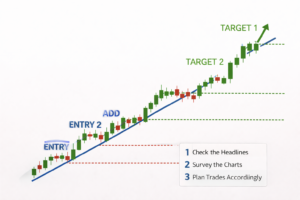
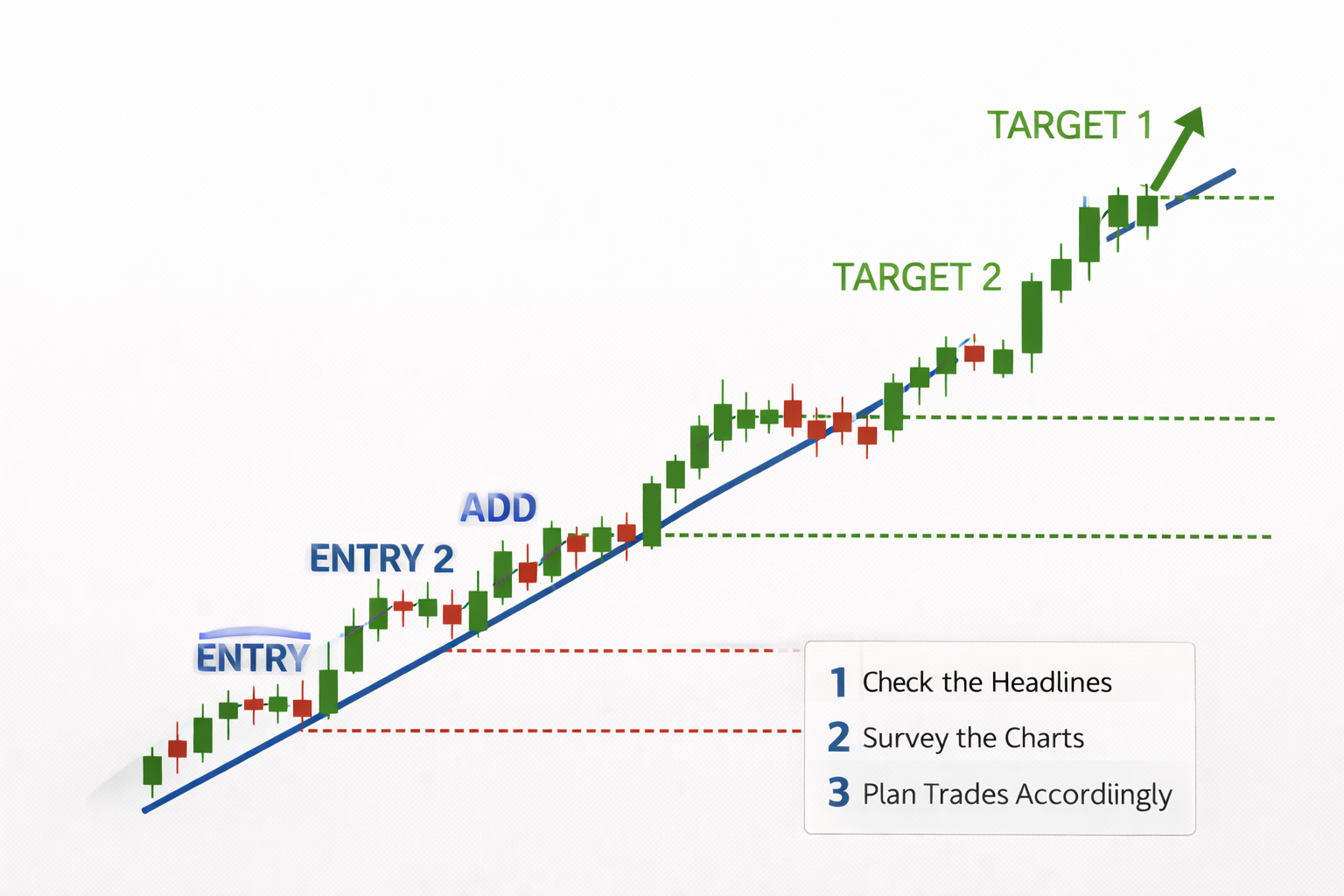
A trader might open a smaller position near support, add after confirmation, and complete the position only if price continues to behave as expected. This can be useful when the setup looks promising but the market has not fully confirmed the idea yet.
That is very different from adding blindly to a losing trade.
When used correctly, scaling into trades helps a trader stay flexible while still respecting risk. It allows for participation without overcommitting too early.
Common reasons traders scale into positions
- the setup is developing but not fully confirmed
- price is approaching a key support area
- volatility is elevated and timing is less precise
- the trader wants to reduce entry pressure
What Does Scaling Out of Trades Mean?
Scaling out of trades means taking profits in stages rather than closing the entire position at one price.
This is often called partial take profit, and it can be especially useful in markets that tend to pause or react at multiple levels. A trade may start well, but that does not mean price will move cleanly to a final target without hesitation.
By taking some profit earlier, traders can reduce pressure and still leave part of the position open for a larger move.
In practice, scaling out is often less about maximizing every last dollar and more about improving consistency. Many traders hold too long because they want the perfect exit. Others sell too early because they fear giving profits back. Partial exits can help balance those two tendencies.
Markets do not move in straight lines for very long.
A staged exit plan can help traders respond to that reality without becoming reactive.
Scaling In Is Not the Same as Averaging Down
This distinction matters.
Scaling into trades is a planned process. Averaging down is often an emotional reaction.
A planned scale-in strategy usually starts with a clear idea:
- where the first entry will happen
- under what condition another add is allowed
- how much total size is acceptable
- where the trade is invalidated
Averaging down without a plan usually happens for a different reason. The trader wants to avoid taking the loss, so they add more exposure without fresh confirmation.
Those are not the same behavior, even if both involve multiple entries.
A useful rule
If the additional entry was not part of the original trade management strategy, it is probably not scaling in. It is probably an unplanned adjustment.
Why Traders Use Partial Entries and Partial Exits
A full-size entry can work well in a clean setup. A full-size exit can also work if the target is clear and the market is moving efficiently.
But real markets are often less cooperative.
Scaling in and out of trades can help traders deal with that uncertainty in a more structured way.
Potential benefits of scaling in
- reduces pressure to pick the exact bottom or breakout point
- allows confirmation before committing full size
- can improve control in volatile markets
Potential benefits of scaling out
- locks in profit along the way
- reduces emotional tension once part of the position is secured
- allows continued participation if the trend extends
- supports a more balanced partial take profit process
This is especially helpful for traders who struggle with all-or-nothing decisions. A structured scaling plan gives the trade room to develop without forcing the trader into a single perfect entry or exit.
A Simple Example of Scaling In and Out of Trades
A basic approach might look like this:
- enter 40% of the position near support
- add 30% after confirmation
- add the final 30% if price shows strength
Then on the way up:
- take 30% off at the first target
- take another 30% off at the next resistance level
- trail the remaining 40% if momentum continues
This is not a universal formula, but it shows how a trader can build a position gradually and reduce it gradually instead of making every decision all at once.
The point is not to memorize percentages. The point is to use a repeatable framework.
When Scaling Works Best
Scaling works best when the market offers logical zones for action.
For entries, those zones may include:
- support
- retests
- breakout confirmation
- reclaim levels
For exits, they may include:
- prior resistance
- measured move targets
- psychological price levels
- trailing stop areas
The best setups for scaling are usually the ones where the market structure gives you a reason to act in stages. If there is no clear structure, scaling can quickly become random.
That is why trade management strategy matters more than the scaling technique itself.
Common Mistakes Traders Make
Even a useful method can become harmful if it is applied poorly.
1. Adding without confirmation
Scaling in should not become a habit of defending bad entries.
2. Taking partial profits too early
Scaling out is useful, but not every trade needs to be cut up too aggressively. If profits are taken too quickly, strong trends may be underutilized.
3. Using too many stages
Beginners often overcomplicate the process. Two or three planned stages are usually enough.
4. Having no written plan
A staged entry or staged exit is only helpful when the rules are decided in advance.
5. Confusing flexibility with indecision
A good scaling plan reduces uncertainty. A bad one simply hides hesitation.
The goal of scaling is not to avoid responsibility.
The goal is to make decisions more structured before emotions take over.
A Simple Scaling Framework
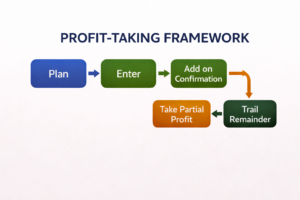
Here is a practical framework traders can use before entering a trade:
Before the trade
- define the setup
- define the invalidation level
- define the maximum position size
- define how many entry stages are allowed
During the trade
- add only if the original conditions still hold
- do not add because of frustration or fear
- reduce size at planned targets, not random moments
After the trade
- review whether the staged plan improved execution
- check whether any entry or exit was emotional rather than planned
- simplify the framework if it becomes too complex
Final Thoughts
Scaling into trades and scaling out of trades can be a smart trade management strategy when used with discipline.
They do not remove uncertainty, and they do not guarantee better results in every market. What they can do is reduce emotional pressure, improve consistency, and make entries and exits more deliberate.
The key is simple: scale with intention, not impulse.
A staged plan should make the trade clearer. If it only makes the decision process messier, it needs to be simplified.
FAQ
Is scaling in the same as averaging down?
Not necessarily. Scaling in is usually planned in advance and tied to market structure or confirmation. Averaging down is often an emotional response to a losing trade.
Does scaling out reduce profits?
It can reduce maximum upside in some cases, but it often improves consistency and makes profit-taking easier to manage.
How many stages should beginners use?
Usually two or three stages are enough. Too many layers can make trade management unnecessarily complicated.
Is partial take profit better than exiting all at once?
It depends on the strategy, but many traders prefer partial take profit because it lowers pressure while keeping some exposure for a larger move.
Can scaling work for swing trading and day trading?
Yes. The concept can work in both styles, as long as the entries, exits, and risk limits are defined before the trade starts.