



How to Set a Stop Loss: A Simple Risk Management Framework
Stop losses are easy to praise and much harder to follow in real time.
Many traders delay them because a stop can feel personal. It can feel like proof that the trade was wrong. But a stop loss is not a judgment on you. It is a practical tool that prevents one bad trade from turning into a much larger problem.
That is why learning how to set a stop loss matters so much. A good entry can still fail. A strong-looking setup can still break down. The stop is what defines the point where the original idea no longer makes sense.
A stop loss is not there to protect your ego.
It is there to protect your capital.
For most traders, stop placement should be part of the plan before the trade begins. If the decision is delayed until after entry, emotion usually takes over.
Why Stop Losses Matter
A stop loss is one of the foundations of trading risk management.
Its job is simple: define the maximum acceptable loss on a trade before that loss becomes dangerous. Without that boundary, traders often hold too long, rationalize bad price action, and turn manageable losses into account damage.
This is one reason many beginners struggle. They spend a lot of time looking for entries and not enough time thinking about what happens if the trade fails.
A stop loss forces that question early.
A stop loss helps traders:
- limit downside on a single trade
- define invalidation before emotions rise
- protect the account from one oversized mistake
- stay consistent over a larger sample of trades
A good stop loss strategy does not guarantee comfort. It creates structure.
How to Set a Stop Loss
The simplest answer is this: place the stop where the trade idea clearly breaks down.
That point should come from market structure, not emotion.
A common mistake is using the same fixed percentage for every trade. While simple, that approach often ignores volatility, chart context, and the actual reason for the trade. A stock moving quietly near support is different from a fast-moving crypto asset breaking out during elevated volatility.
A better method is to ask one clear question:
Where does this trade stop making sense?
That location may be:
- below a key support level
- beneath a recent swing low
- under the base of a breakout pattern
- below a reclaim level that should hold if the thesis is valid
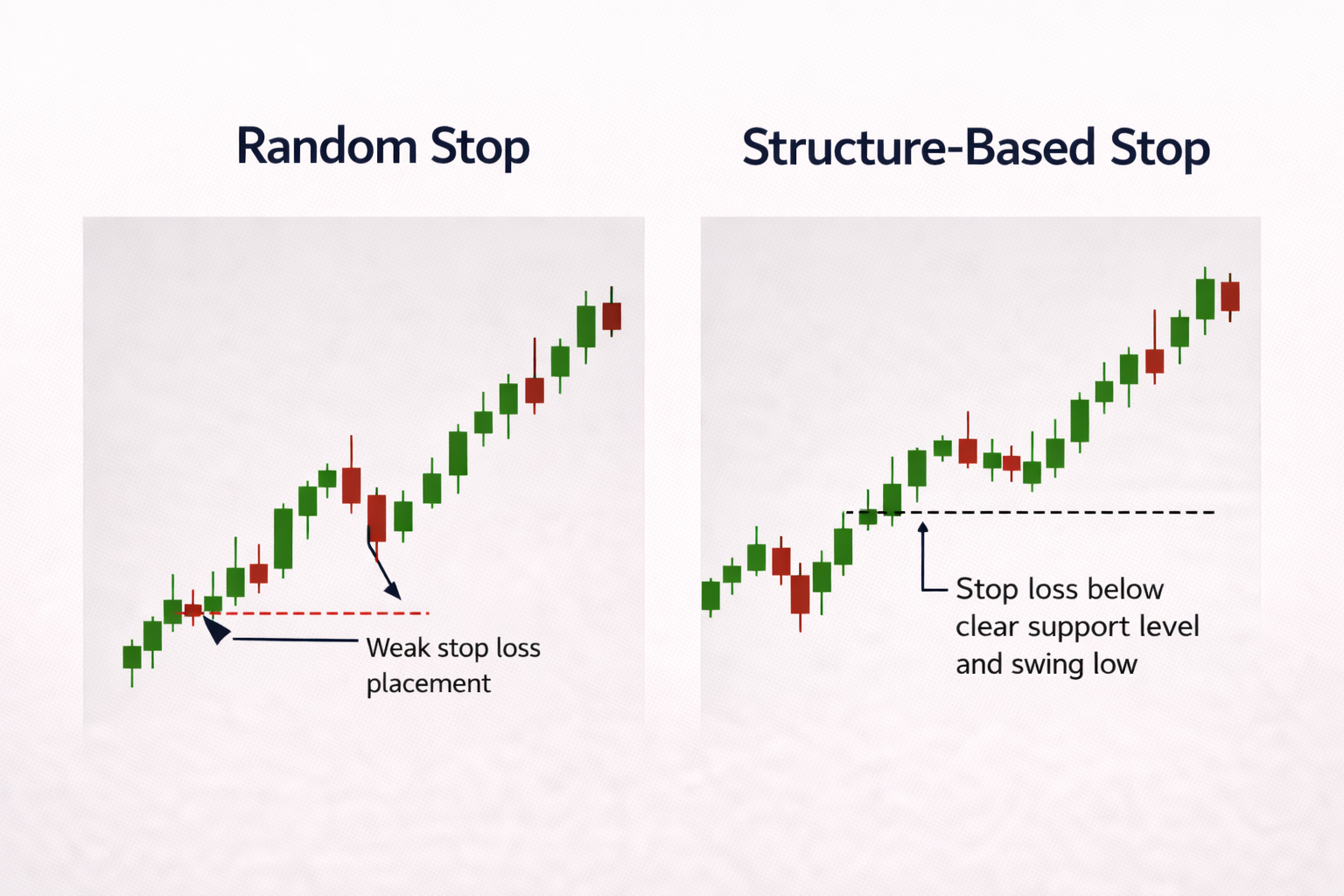
The stop should not be random. It should be tied to the reason the trade exists.
Use Market Structure, Not Emotion
The strongest stop placements usually come from the chart itself.
If you entered near support, the stop often belongs below the level that would prove support failed. If you entered on a breakout, the stop may belong below the base or beneath the most important reclaim zone.
This is what makes structure-based stop placement different from emotional stop placement.
An emotional stop says, “I do not want to lose more than this amount.”
A structure-based stop says, “If price reaches this level, the market is telling me the original idea is probably wrong.”
That difference matters. One is based on discomfort. The other is based on invalidation.
The best stop is not the one that feels safest.
It is the one that honestly reflects where the setup fails.
Before Entering, Define These Three Things
Before any trade, write down these three elements:
- Why are you entering?
What is the setup, and what are you expecting to happen? - Where is the idea invalid?
At what price level does the original thesis break down? - How much of the account are you risking?
What is the maximum acceptable loss if the stop is hit?
This simple exercise can improve stop loss discipline more than most traders expect. It shifts the process from reaction to planning.
Why Position Size Matters Just As Much
Stop placement and position size always work together.
A wide stop is not automatically bad. But if the position size stays too large, total risk can become unacceptable. This is where many traders make a serious mistake. They focus on the stop distance but ignore how much capital is exposed.
If your stop needs more room, your size usually needs to shrink.
That is one of the most important ideas in trading risk management. You do not force the chart to fit your preferred position size. You adjust the size to fit the structure of the trade.
A practical way to think about it
- wider stop = smaller size
- tighter stop = potentially larger size
- same account risk = better consistency
This is why position sizing is not separate from stop loss strategy. It is part of the same decision.
A Fixed Percentage Stop Is Not Always Wrong, But It Is Often Incomplete
Some traders use a fixed stop, such as 3% or 5%, for simplicity. That can create consistency, but it also has limits.
The problem is that markets do not move with the same rhythm across every setup. A 3% stop may be too loose on one chart and too tight on another. In a low-volatility setup, it may expose more risk than necessary. In a high-volatility setup, it may sit too close to normal price movement and get triggered for no structural reason.
That is why fixed-percentage stops often work better as a secondary check rather than the primary method.
The first question should still be: where is the setup invalidated?
Common Stop Loss Mistakes
Even traders who believe in stop losses often misuse them.
1. Placing the stop after entering
This invites emotional decision-making. The stop should be part of the setup from the beginning.
2. Using the same stop distance for every trade
Not every market and pattern behaves the same way. Context matters.
3. Ignoring position size
A wide stop with a large position can still create too much risk.
4. Moving the stop farther away without a new reason
This is often just loss avoidance disguised as flexibility.
5. Jumping straight back in after a stop-out
A controlled loss can turn into emotional overtrading very quickly if the trader re-enters without reassessing the market.
A stop-out is not automatically a mistake.
Refusing to reassess after the stop is often the bigger problem.
What to Do After a Stop Loss Is Hit
Once the stop is triggered, the first job is not revenge trading. It is reevaluation.
Step back and ask:
- does the original thesis still exist?
- has the market structure changed?
- was the stop placed correctly?
- was the loss part of a valid setup, or did the trade break your rules?
This pause matters. Many traders turn one small, controlled loss into a much larger problem by reacting emotionally after the exit.
Sometimes the best next action is to do nothing for a while.
A Simple Risk Before Reward Framework
Many beginners think about profit targets first. In practice, risk should come first.
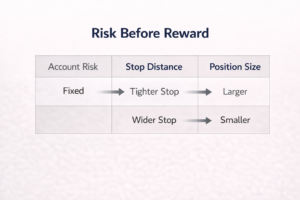
Before entering a trade, define:
- account risk
- stop distance
- position size
- only then, the reward target
This order matters because it keeps the trade grounded in survival rather than excitement.
A setup may look attractive, but if the stop placement forces a position size that does not make sense for your account, the trade may not be worth taking.
That is one reason disciplined traders often think risk before reward, not the other way around.
When Beginners Learn Stop Losses Best
For beginners, the goal is usually not to find the perfect stop. It is to build a repeatable process.
That process should be simple enough to follow under pressure.
A useful starting framework is:
- identify the setup
- identify the invalidation level
- calculate position size based on stop distance
- accept the loss before taking the trade
- review the result without emotion
This is often more helpful than chasing advanced tactics too early.
A stop loss for beginners should be clear, logical, and easy to explain in one sentence.
If the reason for the stop placement is vague, the plan is probably not ready.
Final Thoughts
Learning how to set a stop loss is really about learning how to think clearly before entering a trade.
A stop is not there to make trading comfortable. It is there to make trading survivable. Traders who last tend to treat risk management as part of the strategy itself, not as a backup plan for when things go wrong.
The strongest stop loss strategy is usually the one that connects three things:
- market structure
- invalidation
- position size
Once those pieces are aligned, the stop becomes less emotional and more practical.
That is where better trading risk management begins.
FAQ
Should every trade have a stop loss?
For most active trading styles, yes. A predefined stop helps control downside and keeps one trade from causing outsized damage.
Should I use mental stops or hard stops?
That depends on the market, the instrument, and your discipline. Many beginners do better with predefined execution rules because they reduce hesitation.
Does the same stop loss logic work for stocks and crypto?
The principle is similar, but volatility is different. Crypto often needs more room, which usually means smaller position size.
Is a tighter stop always better?
Not necessarily. A stop that is too tight may sit inside normal price noise and get triggered before the setup has truly failed.
What matters more: stop loss or entry?
Both matter, but many traders underestimate stop placement. A good entry with poor risk control can still become a bad trade.