



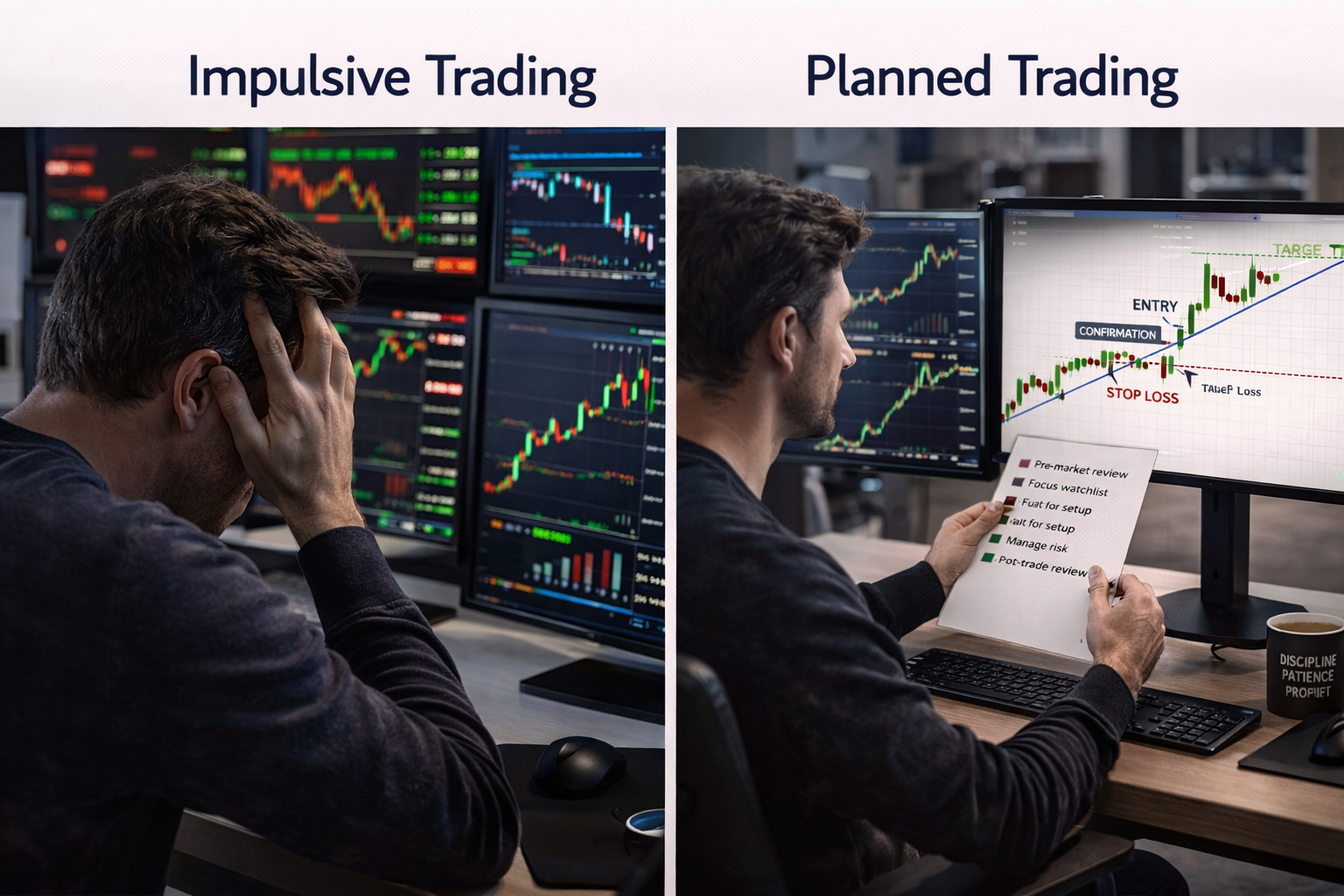
Day Trading for Beginners: 5 Mistakes New Traders Make Early
Day trading means opening and closing trades within the same trading session. On the surface, that sounds appealing. There is no overnight exposure, feedback comes quickly, and the pace feels exciting.
That same speed is also what makes it difficult.
Fast markets punish hesitation, overconfidence, and emotional decisions much more quickly than many beginners expect. A bad habit that might take weeks to become obvious in swing trading can show up in a single morning when you are day trading.
That is why day trading for beginners is rarely just a technical challenge. It is usually a discipline challenge first.
Day trading does not usually fail because the market is too fast.
It fails because the trader has no structure for dealing with that speed.
Why Day Trading Looks Easier Than It Really Is
A lot of new traders are drawn to short-term trading because they assume shorter holding time means lower risk.
That is not always true.
Lower exposure time can reduce some types of risk, but short timeframes also come with more noise, more false moves, and more emotional pressure. The market gives feedback quickly, but it also punishes mistakes quickly.
Another misconception is that one chart pattern is enough. In reality, a setup only makes sense in context. Volume matters. Market conditions matter. Timing matters. A clean-looking pattern on a random chart is not the same as a high-quality setup with confirmation.
This is one reason beginner day trading often feels harder in practice than it looked in theory.
Mistake #1: Thinking Shorter Timeframes Are Automatically Safer
Many new traders assume that being in a trade for only a few minutes must be safer than holding for several days.
But shorter timeframes are often less forgiving.
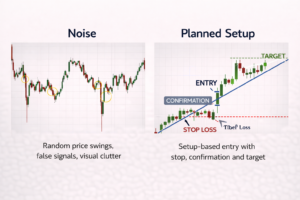
Price moves faster, noise is higher, and false signals appear more often. What looks like a breakout on a one-minute chart may be nothing more than random movement inside a messy session.
That does not mean day trading is wrong. It means the trader needs to respect the environment.
A short holding period does not automatically create good risk management. The real protection comes from position sizing, stop discipline, and selectivity.
Mistake #2: Treating One Pattern Like a Complete Trading System
A common beginner mistake is believing that spotting one pattern is enough to justify a trade.
It usually is not.
A chart pattern without context can be misleading. The same breakout setup can behave very differently depending on volume, overall market tone, time of day, and whether the move is happening into resistance.
This is where many day trading mistakes begin. The trader sees a familiar shape, enters too quickly, and skips the questions that matter.
A better approach is to ask:
- Is volume supporting the move?
- Is the broader market aligned?
- Is this happening at a useful time of day?
- Is price moving into a logical barrier?
Patterns matter, but context gives them meaning.
Mistake #3: Overtrading Out of Boredom or Frustration
New traders often confuse activity with opportunity.
They feel like being at the screen should result in constant action. When the market slows down, they start forcing trades that were never really there. When they miss one move, they chase the next one just to stay involved.
This is one of the most expensive beginner habits.
In practice, many traders improve only after doing less. A smaller watchlist, fewer setups, and clearer rules often lead to much better execution.
A better starting approach
- track only a handful of names
- focus on one or two repeatable setups
- avoid trading every minor move
- accept that some sessions offer very little edge
Quality usually beats frequency.
Good day trading often looks boring from the outside.
That is usually a sign the trader is acting with structure instead of impulse.
Mistake #4: Treating Stop Losses Like Proof of Failure
Many beginners take small losses personally.
They start believing that frequent stop-outs mean they are bad at trading. In reality, stop losses are part of the business. They are not evidence of failure. They are a normal cost of protecting capital.
The real problem is usually not being stopped out. The real problem is refusing to accept a small loss and letting it grow into a large one.
That is where day trading risk management becomes essential.
A controlled loss keeps the account stable. An uncontrolled loss damages not only capital, but also decision-making on the trades that follow.
For most new traders, the goal should not be avoiding every stop. It should be keeping losses small enough that no single trade can damage the week.
Mistake #5: Focusing Only on Win Rate
Win rate is one of the most misunderstood numbers in trading.
A trader can win often and still lose money if the average loss is too large. Another trader can win less often and still be profitable if losses stay controlled and winners are managed well.
This is why win rate alone tells very little.
What matters more is the relationship between:
- average win
- average loss
- position size
- consistency of execution
Many new traders chase the feeling of being right instead of building a process that actually makes sense over time.
That shift, from ego to process, is one of the biggest turning points in trading development.
Why Win Rate Misleads Beginners
A high win rate can feel reassuring, especially early on. But it often hides weak trade management.
For example, a trader who takes tiny profits and occasionally absorbs a large loss may look successful for a while. Then one bad trade erases many small wins.
That is why beginner day trading tips should always include more than entry signals. Without risk-to-reward discipline, win rate becomes a very incomplete metric.
A healthier focus is:
- consistent execution
- controlled downside
- clear risk-to-reward planning
- reviewing whether the trade followed the rules
This creates a more realistic path forward than simply trying to win as often as possible.
A Simple Starting Framework for Day Trading Beginners
A realistic day trading routine does not need to be complicated.
In fact, beginners often do better with a smaller and more repeatable framework.
A practical starting point could look like this:
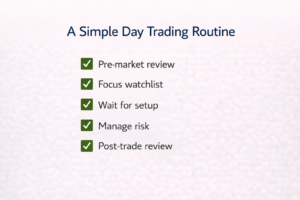
1. Trade at the same time each day
Certain hours tend to behave differently. Repeating the same time window helps you learn faster.
2. Focus on one setup
Do not try to master every pattern at once. One setup is enough at the beginning.
3. Use a maximum daily loss limit
This protects both capital and psychology.
4. Keep a small watchlist
Too many names usually create distraction, not opportunity.
5. Review every trade
The review is where improvement happens. Without it, experience turns into repetition instead of skill.
Planned Trading vs Impulsive Trading
One of the biggest differences between improving traders and struggling traders is not intelligence. It is preparation.
Impulsive trading usually sounds like this:
- “This looks like it might run.”
- “I do not want to miss it.”
- “I will figure out the exit later.”
Planned trading sounds different:
- “This is the setup I trade.”
- “This is the entry condition.”
- “This is the stop.”
- “This is the target or management plan.”
- “If the setup is not there, I do nothing.”
That distinction is simple, but it changes almost everything.
Final Thoughts
Day trading for beginners is possible, but it is usually harder than it first appears.
The speed attracts people quickly. The pressure keeps many of them from lasting. What helps most is not excitement, but structure. A trader improves faster by narrowing the process, respecting risk, and reviewing execution honestly.
Most early progress comes from avoiding obvious mistakes:
- trading too often
- forcing low-quality setups
- ignoring stop discipline
- focusing only on win rate
- reacting emotionally after losses
That may not sound exciting, but it is usually where real improvement starts.
Progress in day trading rarely comes from doing more.
It usually comes from doing less, but doing it with more consistency.
FAQ
Is day trading good for beginners?
It can be done, but it is often harder than beginners expect. The speed of decision-making and the emotional pressure can make the learning curve steep.
Do I need to watch the screen all day?
Usually yes, at least during your trading window. That is one reason some people are better suited to swing trading than day trading.
Should I try to recover losses immediately?
No. Revenge trading is one of the fastest ways to damage consistency and turn a controlled loss into a much bigger mistake.
Is day trading mostly about chart patterns?
No. Patterns matter, but context, timing, risk control, and execution matter just as much.
What should a beginner focus on first?
Most beginners should focus on one setup, one time window, clear stop rules, and a consistent review process.